
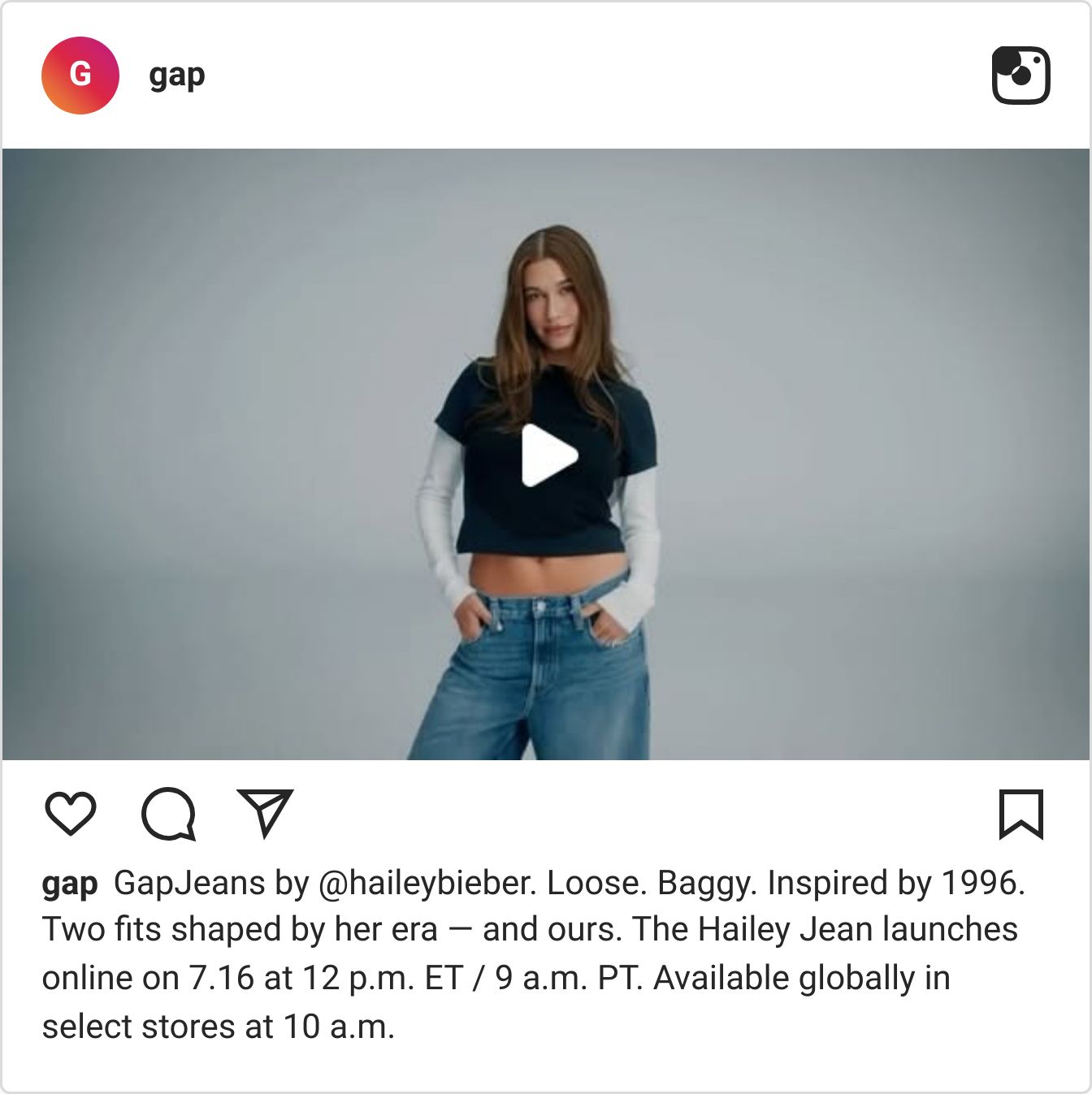
Everyone called the Gap x Hailey Bieber drop a knockout. Jefferies literally walked into the store, then wrote the word "limited." Here's why the gap between "viral" and "revenue" is the costliest mistake in DTC right now, and the Ugg campaign that did it the right way.
It broke the internet. It barely moved the P&L
Let's kill a myth that's quietly costing DTC brands real money.
On July 21, Jefferies sent analysts to physically check the Gap x Hailey Bieber denim drop. Their verdict, in writing: "While the financial impact is limited, we believe the collab reinforces positive momentum within GAP's denim business."
Read that twice. The financial impact is limited.
This is the collab everyone called a knockout. The teaser did 7.2M views and 945K likes on TikTok. The Times Square store was picked clean of sizes by mid afternoon on drop day. The July 18 restock sold out again. Bieber's combined Instagram and TikTok reach is 77.3M. And Gap stock is still hovering around $20, down roughly 23% on the year.
Here's the trap:

"it sold out" and "it moved the business" are not the same sentence. You can sell out a small, limited capsule in an afternoon and generate a rounding error in revenue. Scarcity is a content strategy. It is not a growth strategy.
So what did Gap actually buy? Repositioning and traffic. A 77-million-person megaphone pointed at "Gap is cool again." That's real value. It's just brand spend, not a sales line. Book it that way and you'll make smarter calls about what comes next.
Now look at the same week, done differently

On July 23, Ugg dropped its back-to-school campaign with the band Muna. On paper, a smaller play. Mid-tier artist, not a Bieber-sized name. But look at what they stacked on top of the cultural moment:
→ A college ambassador program pulling student creators from SCAD, FIDM, and the Art Institute of Chicago → Real cause partners (Queer|Art, Chicxs Rockerxs SELA) to earn credibility instead of buying it → A hard commerce mechanic: spend $150+ in store and you get a custom coloring book and crayons → A 10% student discount through Unidays (plus 10% for teachers via SheerID)
Ugg didn't just rent attention. They bolted a purchase incentive, a discount trigger, and a reason to walk into a store directly onto the culture moment. And the base business is already working: Ugg brand net sales were up 8.2% to $2.74B for fiscal 2026.
That's the difference between a viral moment and a commerce engine
The operator takeaway:
A celebrity capsule can own TikTok for a week and be worth almost nothing on your P&L. That doesn't make it a bad buy. It makes it a brand buy. The real mistake is expecting a repositioning play to show up as revenue, then panicking when it doesn't.
If you want the moment to actually sell, you have to build the mechanic yourself:
→ Creator or celebrity = the reach → Cause or community = the credibility → Discount, gift, or spend threshold = the conversion
Stack all three, or you're just paying for applause.
One more thing worth stealing from Gap: instead of one-and-done scarcity, they manufactured a second viral moment with a next-day 7am restock. Same product, two spikes of demand. If you're going to do the drop, at least get two headlines out of it.

